Static to Signal:
30-Day Art Journaling Practice
30 days. No art experience needed. Just a willingness to explore.
You're exhausted from holding it all together
The Static is the noise when everything is happening at once. Thoughts racing, emotions swirling, sensations you can’t name, like 300 radio stations playing in your head and none of them are clear. Life piles on, notifications, tasks, expectations, and your own voice gets scrambled.
You are not broken. You are not alone. Portals are how we navigate the Static. Every page is a doorway through the noise. Showing up, even for a few minutes, is a step back to yourself.
You've tried regular journaling. You've tried meditation, talking to friends, all the "right" things. And some of it helps. But it's not enough.
Because talking about your feelings requires words. And sometimes you don't have words. Sometimes you're too exhausted to articulate what's happening inside you. Sometimes it's 2am and there's no one to call.
You need a different way. A portal out of the static. A way to externalize what you're carrying so it stops living only in your body and mind.
That's what art journaling does.

Art clears the frequency
Here's what happens when you make art:
The Static quiets. The million channels playing at once? They fade into the background. You can finally hear your own voice. Your intuition. The clear signal underneath all the interference.
It's immediate. Not after 30 days. Not eventually. The first time you put marks on a page and let your hands move without thinking, you feel it. The relief. The presence. The 'oh, I can actually do this.'
Art journaling activates a different part of your brain than writing or talking. It bypasses the inner critic, the judgment, the need to make sense. It lets you process emotions you can't name. It opens a portal between what's stuck inside and what needs to be expressed.
And it's scientifically proven to help:
✔ Regulate your nervous system
✔ Reduce anxiety and depression
✔ Process trauma stored in your body
✔ Increase mindfulness and presence
✔ Build emotional resilience
But more important than any research? It works. You know it works because you feel different after you make something. The chaos becomes manageable. The weight becomes visible. And once you can see it through this portal, you can work with it.
30 days to build a practice that saves your life
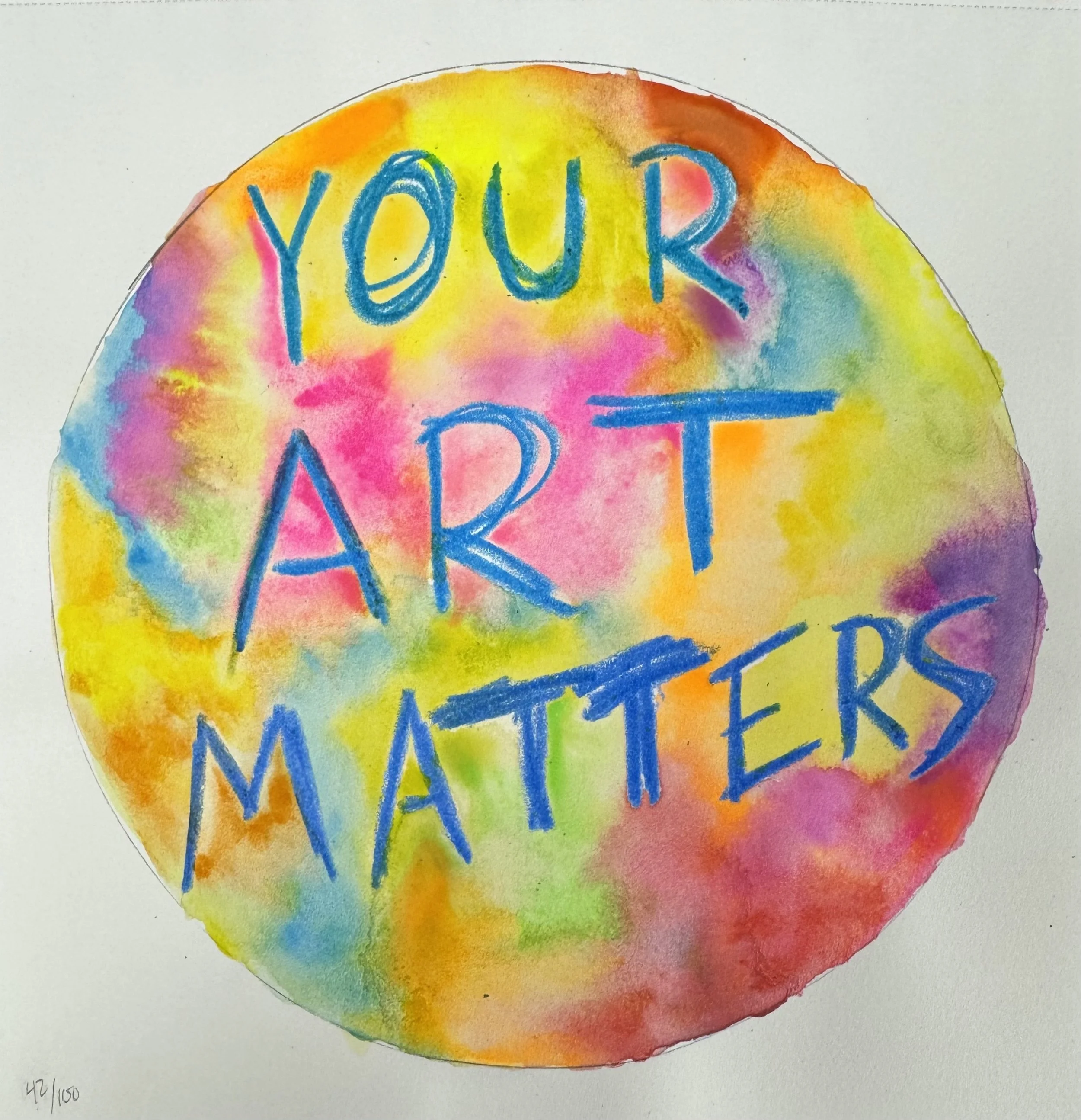
This isn't a one time thing. This is building a tool you'll use for the rest of your life.
For 30 days, you'll get a daily art journaling prompt. Some will feel simple. Some will crack you open. Some you'll hate. Some will be life changing. That's the point. You're experimenting. You're tuning the dial to find what frequency works for YOU.
By the end of 30 days, you'll have:
A practice to return to whenever life gets hard, whenever you're overwhelmed, whenever words aren't enough
A regulated nervous system because art-making literally calms your body down
A tool for the 2am moments when you're feeling crazy and have nowhere to put it
A record of your life, like photos in an album, filled with moments that deeply resonated, feelings you processed, things you survived
A quieter mind because you've trained your brain to process through making instead of just thinking
More trust in yourself because you showed up for 30 days and proved you can do hard things
Permission to be messy because you've made 30 pages of "bad" art and realized it doesn't have to be good to help
This practice becomes your portal home. When the world is on fire. When you're losing yourself in someone else. When the grief is too big for words. When you just need to be present with yourself for 20 minutes.
Art journaling saves lives. It saved mine. Multiple times.
Art Journaling saved my life
I'm an art therapist and clinical counselor. I work in addiction recovery with people in some of the hardest moments of their lives. And I watch them discover that making art helps, even when they think they're 'not creative,' even when they've never done this before.
But here's the thing: I still need this practice myself.
Art journaling has been my anchor through every storm, grief, sobriety, anxiety, trauma. It's how I stay grounded when everything else is chaos.
And I still use it. Almost addictively. I carry several sketchbooks around because I never know when I'm going to need to open a portal, to put something down on paper instead of holding it inside.
This isn't something I did ten years ago and moved past. This is how I stay sane. This is how I tune out the static and find the clear channel back to myself.
And if you're someone who feels too much, who's overwhelmed by the world, who needs a way to process that doesn't require more talking, this is for you.
What you actually get:
30 daily art journaling prompts
Guidance on materials, techniques, and building your practice
Personal stories from my life woven throughout each week
Permission to do this messy, imperfectly, in whatever way works for you


Step through the portal if:
Talking about your feelings isn't enough anymore (or feels exhausting)
You're overwhelmed by the world, people's energy, the news, expectations, all of it
You feel disconnected from yourself and want to come home
You want a practice that's portable, affordable, and always available

Who This Is Not For:
This experience might not be for you if:
You want art therapy (this is educational, not clinical treatment)
You're looking for something that will "fix" you in 30 days (this is a practice, not a cure)
You're not willing to feel uncomfortable (some prompts will bring up hard stuff)
You want someone to tell you exactly what your art means (you interpret your own work)
FAQ
-
Absolutely not. This isn't about skill. This is about having a tool to process emotions. If you can hold a marker and make a mark on paper, you can do this.
-
Whatever you have. Pen and paper. Markers. Crayons. Old magazines. Junk mail. The course includes a full supply guide, but the barrier to entry is intentionally low. You don't need fancy materials.
-
You will. Everyone does. The practice isn't about perfection, it's about showing up when you can. Do the prompts in order, skip around, go at your own pace. There's no "falling behind."
-
No. This is an educational course teaching you art journaling techniques. It's not clinical treatment. If you're in crisis or need therapeutic support, please work with a licensed professional.
-
Perfect. That's information. Some prompts will resonate, some won't. You're figuring out what works for YOU. Skip the ones that don't land. Come back to the ones that do.